Sunday, June 14, 2020

The Top 10 Public Golf Courses in Baltimore

The Baltimore metropolitan area is one of the elite locations along the east coast to play high-quality golf. Its Mid-Atlantic location presents the ideal weather for any golfer, with a cooler summer than more southern states, and longer, crisper autumns, compared to the much colder states to the north. Most years, you can play year-round at any of the incredible, challenging golf courses that circle Baltimore’s urban hub. 

The city is surrounded by some of the finest private golf and country clubs in the region, such as Baltimore Country Club (Five Farms) and Caves Valley Golf Club, which is set to host the BMW Championship of the FedEx Cup Playoffs in 2021. However, for those who are just visiting the area, or for the golfers on a budget, here are my top 10 public golf courses in the Baltimore area. Please keep in mind that this list is constantly changing and evolving! And, feel free to comment with your personal favorite courses.

10. Fox Hollow Golf Course (Baltimore County Golf): Lutherville-Timonium

Fox Hollow is a relatively forgiving course with wider fairways and opportunities to score well left and right. It’s listed as a 6,129 yard par 70 from the tips and plays every bit of it. Number 12 is a lengthy 614 yard par 5 that swirls out around the driving range. Speaking of, Fox Hollow is known for its state-of-the-art practice facility, that includes driving range, wedge target course, pitching and chipping green, and three practice putting greens. It was recently named a top 50 practice facility in the country by the GRAA.

9. Compass Pointe Golf Courses: Pasadena

Compass Pointe boasts 36 holes sprawled out over two fantastic 18-hole courses, as well as a driving range, bountiful pro shop, and Bogey’s Grill. The North-East course is a long, challenging par 72. It spans over 7,134 yards, highlighted by the 622 yard par 5 9th. Rumors here often circulate that there was “one guy” that was able to reach the green in two. Although, Natty Bohs seem to blur some memories on how high the wind was that day, or if the hole was redesigned altogether since then, or if it was the same day that group saw Bigfoot in the woods.  The South-West course is a narrow challenge with scoring opportunities for golfers of all skill levels. It is a par 72 6,979 yard course that requires accuracy and precision.
8. Rocky Point Golf Course (Baltimore County Golf): Essex

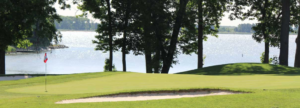
With some of the most breathtaking views you will find in the Baltimore area, Rocky Point is one of the most picturesque, yet challenging courses around. Surrounded by preserved natural wetlands, this 6,650 yard par 72 course is a completely fair challenge for golfers of all skill levels. The front 9 plays out with fairways  lined with trees, while the more scenic back 9 challenges you against the water. One of my favorite par 3’s on this list is the 11th, which is a soft wedge down a hill with a picturesque view of the Chesapeake that will have your foursome challenging each other for closest to the pin.

7. The Woodlands (Baltimore County Golf): Windsor Mill

The Woodlands is a challenging test for all golfers. Undulating greens cap off long bent-grass fairways lined with hardwood trees. It’s one of the more difficult of the BCG courses, setting up over 7,000 yards. It’s practice facility is pristine with a driving range, wedge target course, practice bunker, pitching/chipping green and two practice putting greens. It also shares a clubhouse with Diamond Ridge Golf Course, another fantastic BCG course, which is an honorable mention for this list.

6. Mountain Branch Golf Club: Joppa

Mountain Branch plays host to many of Maryland’s Amateur Qualifiers, and for good reason. Sprawling over 264 acres in Harford County, the course has received many accolades for its beautiful layout and difficult play. The course plays over 7,000 yards and offers elevation changes, water trouble, and rolling greens.
5. The Timbers at Troy: Elkridge

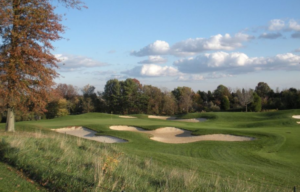
The land’s history is rich, dating back to the 1600s and through the Revolutionary War. Following an update in the winter of 2016-17, the Timbers at Troy challenges golfers with every shot, causing an internal war with yourself. Rolling hills and pristine bunkers force golfers to remain precise, yet long. The 6650 yard par 72 is highlighted by the treacherous “Timbers Amen Corner” from holes 9-12. This brutal stretch is one of the most difficult in the area.

4. Pine Ridge Golf Course (Classic Five): Lutherville-Timonium

Pine Ridge offers some of the best water views that any Baltimore-area golf course can offer due to its location on Loch Raven Reservoir. Over the years, it has hosted numerous PGA and LPGA events, including Nancy Lopez’s second tournament win ever. It plays over 6,800 yards and is highlighted by long par 5’s and narrow fairways lined by tall pine trees. It offers an excellent driving range, as well, and plays host to the golf education of many of the area’s top junior players.

3. Mount Pleasant Golf Course (Classic 5): Baltimore

“That’s it, I quit.” We’ve all said this during a round of golf before, maybe multiple times per round, but this famous sentence was uttered by the great Arnold Palmer after he yanked his tee shot over Hillen Road, which runs parallel to Mt. Pleasant’s first fairway during the Eastern Invitational in 1956. The King went on to win the tournament for his second US victory on tour. Mt. Pleasant golf course oozes tradition. From the clubhouse to the course, it’s a spectacular and fun challenge within Baltimore’s city limits. Winding, narrow fairways and subtle elevation changes challenge golfer’s as the approach flawless, yet slippery greens. At 6,700 yards, the par 71 course has a fun front 9 that sucks you in before a tight, difficult back 9 spits you out. Mt. Pleasant is sure to offer golfers a good time and a bit of nostalgia.

2. Greystone Golf Course (Baltimore County Golf): White Hall

Greystone was designed by Joe Lee, the designer of Doral’s famous Blue Monster. The course offers a unique 5 par 3’s and 5 par 5’s. 80 bunkers, 7 ponds, and 140 feet of elevation change highlight this difficult test, which plays all of the 6,900 yards. It is highlighted by the sneaky par 3 eighth, which often presents a sucker pin on a green downhill next to some water. and a “longer than it looks” brutal uphill 9th that is a grueling test forcing you to earn your beer at the turn. It’s listed at 446 from the tips, but goes straight uphill to the amazing clubhouse with plenty of trouble on the left and multiple bunkers protecting the green ready to swallow up your approach. The course also offers a driving range, large practice putting green, and a 50 yard simulated fairway into a chipping/pitching practice green.

1. Bulle Rock Golf Course: Havre de Grace

Bulle Rock is a Pete Dye-designed course named for the first thoroughbred stallion to ever be brought to the US. This thoroughbred of a golf course has been voted #1 in Maryland and a top-50 course in the United States. Bulle Rock plays out at a lengthy 7,375 yards and offers a challenging, yet fair test to all golfers. Sloping fairways and thick, unforgiving rough set up to slick greens that offer a test for golfers. Extremely long par 5’s will make even the longest hitters sweat, while challenging par 3’s and tricky 4’s complement the course so well. A round at Bulle Rock will leave you speechless. 

The post The Top 10 Public Golf Courses in Baltimore appeared first on FX Physical Therapy.


Friday, June 12, 2020

Mountain Bike Set Up: Reduce Pain and Discomfort on Long Rides. 

By Dr. Colin van Werkhoven, PT, DPT, CSCS 


Saddle Height:

The height of your seat is very important when it comes to pedalling efficiency and power output when out on the trail. If your seat height is not fit to your body correctly, it could also lead to numbness in your feet, or pain around your knees and hips. If you are overreaching for your pedals, your hips will rock back and forth on your seat causing unnecessary stress on your muscles, nerves, and tendons. This stress, which could last over hours depending on the type of ride you are doing, can have negative side effects in the long term on your health and riding capabilities. Research shows that a 10-15 degree bend in your knee at the lowest position of the pedal stroke allows for the most consistent power output, while also reducing stress on the structures of your leg. 


Handlebar: 

There are a lot of different variations of handlebars out there – before you change material or width, make sure you have them set up correctly. Different handlebars have varying degrees of sweeps and rise – however the common denominator is your wrist positioning. The strongest long term position for your wrist is a straight (or neutral) position. This gives your arm the best mechanical advantage without relying completely on the musculature of your forearm to hold you in a flexed or extended position. The rule of thumb to make sure your wrist is in a neutral and strong position is you should be able to draw a straight line from your shoulder to your index finger on your brake lever. 


Reach: 

This measurement is based on the relative distance between your bottom bracket and your stem. On modern mountain bikes, reach is an incredibly important measurement for bike fit, mechanics, and your most common type of riding. However, after you buy your frame there is only one way to manipulate this variable – adjusting your stem length. Be cautious with making too drastic of a change because this can affect the handling of your bike dramatically at times. This positioning setup is not as straightforward compared to the two previous adjustments. If your reach is too long on your bike you are more likely to have lower and mid back issues arise. If the stem is too short, you are at risk for having your wrists extended too much and not in the optimal straight line position as mentioned above. So if you start having back issues or feel too stretched out on your rides, shorten the stem, and if your wrists are hurting and feel the handlebars are too close to your knees – lengthen the stem. Additionally: Increments of 10mm at a time are a good guiding range when making changes.

The post Mountain Bike Set Up: Reduce Pain and Discomfort on Long Rides.  appeared first on FX Physical Therapy.


Friday, June 5, 2020

Train Smarter, Not Harder During Lockdown: How to not become an injury statistic when sports finally resume

With the heartbreaking cancellation of all spring sports due to COVID 19, from the youth level all the way up through the professional level, many athletes lost their motivation. Here are a few reasons why this is actually the most important time to be training smarter in a time when we can’t necessarily train harder. 

There are many sources comparing this lockdown of society to the 2011 NFL lockout. Quick refresher for those that forget the details.

  • Players were prevented from accessing their team facilities or contacting staff from March 11 through July 25 (= four and a half months)
  • Training camp lasted 17 days instead of 14 weeks
  • There were 10 Achilles ruptures in the first 12 days of training camp (compared to 10 ruptures the entire previous season)

Why this matters to you as an athlete, no matter what level of competition or sport.

  • Lockdown has already last 10 weeks in the state of Maryland with no clear end in sight
  • Use it or lose it! 
    • Cardiovascular endurance changes occur within first 3-4 weeks
      • Body no longer produces red blood cells at the same rate, decreased capillary density
      • What that means in terms that make sense: losing minutes off of your 5K time
    • Loss of muscle strength, muscle atrophy
      • According to NASM (National Academy of Sports Medicine), there are signs of molecular atrophy within a week of inactivity 
      • Once no longer training the Type II fibers, the body stops growing them (hypertrophy) and strength decreases
        • 2013 systematic review on “elite” football and rugby players showed athletes strength decreased in 3 weeks of stopping activity with continued decreases in strength as well as muscle mass the longer inactivity lasts

How to not become a statistic at the end of this pandemic lockdown

  • Train your cardiovascular endurance however you can with the equipment you have access to
    • Bike? Great! Treadmill? Awesome! Rowing erg? Lucky you! No equipment at all? No problem! Take to the streets for a run or even do stairs in your home. 
    • Injuries in sports also come from fatigue, not just contact, so maintaining cardiovascular endurance is essential.
  • Work on the little things now
    • Form- without access to the gym or heavier weights, now is the perfect time to unload and really focus on form and technique for your lifts. 
      • Use a mirror or video yourself to watch for movement faults 
        • A great FREE app to video with is Hudl Technique. It allows you to watch the video in slow motion as well as a ton of other cool tricks!
      • See something off but don’t know how to fix it? Call your favorite PT, we can help!
        • We are offering both telehealth and in person visits at this time
        • Even in telehealth we can watch you and talk you through corrections while on video with us!
    • Accessory muscle/stability muscle work-
      • Work on the smaller muscles that help with stabilization during this time. Most of these exercises can be done with little to no equipment.
        • Reach out to your PT for sport specific exercises that will help set you up for success (ex: shoulder accessory muscle work for swimmers, hip/core work for a cutting athlete)

Possible injuries that could arise if you are not diligent about putting in work during the quarantine and then return to full level sport. 

  • Tendinitis (achilles, patellar, rotator cuff, etc)
  • Bursitis (hip, knee, etc)
  • Ankle sprains
  • Muscle strains (quad, hamstring, hip flexor, etc)
  • Low back pain
  • ACL tear
  • Achilles rupture
  • Rotator cuff/SLAP tear

The post Train Smarter, Not Harder During Lockdown: How to not become an injury statistic when sports finally resume appeared first on FX Physical Therapy.


Friday, May 29, 2020

How Can Physical Therapy Help Me During a Pandemic?

How Can Physical Therapy Help Me During a Pandemic?

In the era of COVID, a brand new life language has been forced upon us. We now embrace solitude for the sake of our community and avoid physical interaction as an act of kindness towards our friends, families, and neighbors. The landscape of many industries has evolved rapidly, and our adaptation skills have been tested perhaps now more than ever. While we all settle into our new normal, the FX Physical Therapy family is here for you to support this transition (spoiler alert: in more ways than just providing exercise!).


Let’s Begin with the Obvious: Physical Activity

You knew this was coming! The imperative role of physical activity in disease prevention (and improving mental health, mood, sleep function, etc) is not a new one. Even without a global pandemic, the CDC recommends 150 minutes of moderate-intensity aerobic activity or 75 minutes of vigorous-intensity physical activity for adults per week. Social distancing guidelines, gyms being closed, and people appropriately adhering to stay-at-home orders introduce new obstacles for this goal to be achieved. How can we create feasible and sustainable ways to incorporate physical activity into your day? First, we listen to you and hear the ins and outs of your new routine. We also take into account the space, time, and equipment you have available at home to create a custom and effective plan to keep you moving and healthy.


Already Exercising?

Great! With many studios and trainers moving to virtual platforms, there are an endless number of resources available for home workouts. Even if you’ve already got a routine that works, it couldn’t hurt to sprinkle in some accessory work and prehab to mitigate the chances of injury and keep your joints, muscles, and nerves moving optimally!


Not Exercising But Still Feel Exhausted?

Believe it or not, feeling increased fatigue with decreased activity during these times is completely normal! Just like exercise places demands on your physical being, high levels of stress and uncertainty place demands on the nervous system. Go easy on yourself for feeling tired and place as much emphasis on getting enough sleep, proper nutrition, and hydration as you place on getting physical activity. There are lots of tips and strategies we can use to find this balance.


Working From Home?

If you find yourself having aches and pains after a full day of sitting for virtual work meetings, you’re certainly not alone. Many of us had to quickly fashion a functional work space from home, and it may not be ideal. Let us meet with you virtually and take a look at your set up to make recommendations. 


Just Overall Lacking Motivation?

We. Hear. That. So let’s work together on the accountability front! We can take this opportunity to really take a deep dive into your programming and make sure that it’s checking all of the boxes. Let us provide some structure to your week and allow you to continue making strides forward. If there’s one thing we know, it’s that we are stronger together.

The post How Can Physical Therapy Help Me During a Pandemic? appeared first on FX Physical Therapy.


Friday, May 15, 2020

Lyme Disease and Tips to Prevent It

Lyme Disease and Tips to Prevent It

Spring is here and many of us are itching to get outside and enjoy the nice weather, especially with this quarantine! With the return to warmer outdoor activities (and still maintaining at least 6 feet of distance), it is important to keep in mind the dangers of ticks and Lyme Disease. May is National Lyme Disease Awareness Month so what better time to spread some information on what Lyme Disease is and how to prevent it. 


What is Lyme Disease:

Lyme disease is a bacterial infection that enters a human host by way of blacklegged tick bite. The blacklegged tick is tiny and can be difficult to find when attached to a person or animal. Because the tick is so small, many people do not even notice when they have been bit. 


Signs and Symptoms: 

A rash shaped like a bull’s eye is one of the most characteristic symptoms of Lyme; however, the estimates of people who develop a rash range widely. Other symptoms include:

  • Arrhythmias (palpitations or irregular heart beat)
  • Chills
  • Facial drooping
  • Fatigue
  • Fever
  • Headaches
  • Lightheadedness 
  • Muscle and joint pain
  • Shooting pain/numbness/tingling in the hands and feet 
  • Stiffness 
  • Weakness


Ways to Prevent Lyme Disease: 

  • Limit skin exposed by wearing long pants, long sleeves, and shoes.
  • Wear light colored clothing to make it easier to see ticks.
  • Walk in the middle of trails to avoid tall grass. 
  • Use tick repellent spray on skin and clothes. 
  • Do check ticks immediately and 3 days following outdoor activity.
  • If you find a tick, remove it carefully and save it.
  • Don’t forget about your furry friends! Ask your veterinarian about protection.


Physical Therapy:

If someone is diagnosed with Lyme, physical therapy can be beneficial with the fatigue and joint/muscle pain. Our manual techniques and individualized exercise program will assist in decreasing pain, improving symptoms, and getting you back to activities you love!

The post Lyme Disease and Tips to Prevent It appeared first on FX Physical Therapy.


Friday, May 8, 2020

Barre for Back Pain

Did you know that working on your glutes is not just great for that summer swimsuit, but your back might thank you too!  Some of the major causes for lower back pain come from posture, and a change in our hip strength over a period of time.  Sitting for extended periods of time may cause our hip flexors to get tight, we lose our hip extension mobility and flexibility, and in return our glutes become inactive and weak.  This reduces the stability that we have in our lower back, and over time can cause muscle guarding and pain.  


In barre class,  we focus on the 360 degrees rule in which we want to load the joint at all angles. So with regards to the hips,  we move the leg outward, forward, backward, as well as inward (technical terms include abduction, extension, flexion, and adduction).  We focus on moving with smaller, more isometric movements that are safer and allow for more control and less use of momentum which is better for building strength and stability.


It is common for participants to report increased flexibility after working through their barre classes as a result of using a technique we refer to as reciprocal inhibition in which you use a muscle on the opposite side of the joint to stretch a muscle that opposes it.  For example, moving into hip extension to work on the glutes in order to stretch out the tight hip flexor.  


It is also important to consider our core strength when we are focusing on reducing low back pain.  With our varied postures, child-birth, fluctuations in weight, poor breathing patterns, we often lose our ability to properly and effectively activate our core.  And to note, core is more than just our abdominal muscles.  The core includes our pelvic floor, rectus abdominis,  transverse abdominis, lumbar multifidus, erector spinae, and diaphragm.  All of these muscles when working together, and efficiently support the back allowing less stress on the spine.  


It is also important to note that with stress, pain, and attempts at maintaining “proper” physique or posture,  we tend to lose our ability to use diaphragmatic breathing.  This causes an over-use of our accessory breathing muscles which can cause neck tension, also reducing core strength. Breathing properly during our exercises is very important for creating spinal stability.  Barre can help you bring your focus and attention back to this, and you might even find that you feel a bit lighter after your class!


One thing we love about barre is that there are many modifications so we can help all ages, and all fitness levels.  We also can perform many of the exercises without equipment, so home workouts can be just as beneficial when they are needed.  Physical therapists use many of these exercises to help their patients, and encourage patients to utilize these programs as additional opportunity to be compliant with their exercise programs and find something they enjoy participating in that will help them in the long term.  


If you want to learn more about barre, how it can help your back pain and overall wellness, please join us on Tuesday, May 12th at 5pm on our Instagram Live with one of our physical therapist Jessica Mertz as well her co-host Stacey Vandiver who is owner of SoulBody Barre.

The post Barre for Back Pain appeared first on FX Physical Therapy.


Monday, February 17, 2020

Spring 2020 Events In Baltimore

After a long and cold winter season, there is nothing like the fresh air of spring in Baltimore. The sunny and pleasant weather with stunning flower blooms everywhere makes going out even more wonderful. Enjoy most of this season while it lasts.

There are lots of wonderful events that take place in the months of spring since it is the busiest season in terms of tourism. Go out, enjoy the sun, and take in the beautiful scenery.

Here are the best spring 2020 events that will take place in Baltimore.

“It Means Desert, Desert”

13th February – 12th March 2020

Location: Julio Fine Arts Gallery at Loyola University 

Event Details

This is a solo art exhibition by Jackie Milad. It will feature various art forms such as audio, video, painting, cut-outs, drawing and collage. All of it is inspired by Jackie’s recent trip to Egypt and the name of the exhibition reflects that.

Queens Girl: Black in The Green Mountains

3rd March – 12th April 2020

Location: Everyman Theatre

Event Details

Directed by Paige Hernandez and written by Caleen Sinnette Jennings, this is the third and final chapter of the famous Queens Girl series. The main character in this play goes through a struggle to find her identity when she reaches Vermont College during the Vietnam War. During this period, there was a civil rights struggle and this makes it even harder for the protagonist to find her place in society.

Baltimore Old Time Music Festival

March 13th – 14th 

Location: Creative Alliance

Event Details

Hosted by Brad and Ken Kolodner. This festival’s line up includes Bill and the Belles, Foghorn Stringband, T-Mart Rounders, Amythyst Kiah, Red Tail Ring, Becky Hill, and many more artists.

Orioles Opening Day

March 26th 

Location: Oriole Park

Event Details 

If you love baseball then this is the ultimate event for you. The opening day will be between the Orioles and the Yankees. Don’t miss this high spirited sports event that is surely not going to bore you.

Where We Stand

April 2nd – 26th 

Location: Baltimore Center Stage

Event Details

Written by Donetta Lavinia Grays and directed by Tamilla Woodard, Where We Stand play has elements of drama, humor, emotion, and music. It is a theatrical piece of art that is about a man whose only source of companionship is taken away and only a kind stranger can change everything in the town which is devoid of compassion.

Maryland Film Festival

April 29th –May 3rd 

Location: Various locations that include 5 W. North Avenue, SNF Parkway, and many more nearby locations

Event Details

The Maryland Film Festival will have a ton of films that you can see, from documentaries, short movies, and features on topics that most filmmakers don’t highlight. There are some intriguing and intense films in there that are sure to make your jaw drop.

These are some of the best events to go to in Baltimore during spring 2020 and be sure not to miss out on any one of them!

The post Spring 2020 Events In Baltimore appeared first on FX Physical Therapy.


Celebrating 5 Years as FX Physical Therapy: A message from Jerod Felice

FX Physical Therapy Celebrates 5 years! From a single flagship location in Hunt Valley, to 9 different clinics throughout Maryland and Virg...